
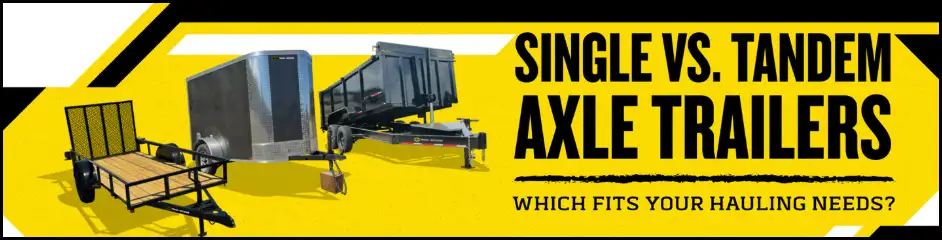
Single vs. Tandem Axle Trailers: Which Fits Your Hauling Needs?
Whether you’re hauling a riding mower to a property, transporting a side-by-side for a weekend adventure, or moving equipment to a job site, choosing the right trailer starts with understanding your hauling needs.
One of the biggest decisions trailer buyers face is whether to choose a single-axle or tandem-axle trailer. While the difference may seem straightforward, the right choice can affect everything from towing performance and maintenance costs to payload capacity and long-term value.
The best trailer is the one that safely and efficiently handles the work you need it to do. Here’s what you need to know before making a decision.
What Is a Single-Axle Trailer?
A single-axle trailer has one axle and two wheels. These trailers are typically lighter, easier to maneuver, and more affordable than tandem-axle models.
Because they have fewer components, single-axle trailers generally require less maintenance over time. They are also easier to move by hand when parking, storing, or positioning the trailer in tight spaces.
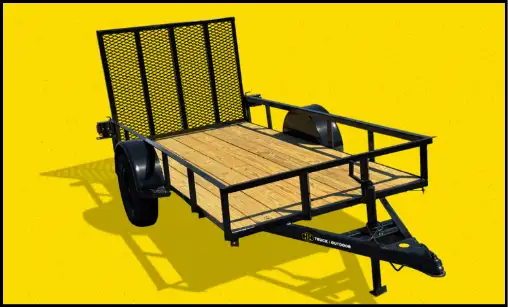
Single-axle trailers are commonly used for hauling:
- Lawn mowers and landscaping equipment
- ATVs and recreational gear
- Home improvement materials
- Furniture and household items
- Yard debris and light-duty loads
At H&H Truck and Outdoor, many utility and enclosed trailer options fall into this category. Single-axle utility trailers ranging from approximately 5-by-8 feet to 6-by-12 feet are often a practical choice for homeowners, hobby farmers, and weekend warriors who need dependable hauling capability without excess trailer weight.
Another benefit of single-axle trailers is affordability. For customers who only haul occasionally, a single-axle trailer can provide the functionality they need without the additional expense of a larger tandem-axle model.
What Is a Tandem-Axle Trailer?
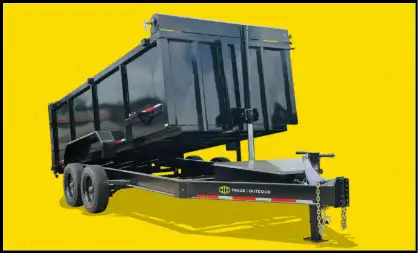
A tandem-axle trailer features two axles and four wheels, allowing weight to be distributed across four tires instead of two. This design generally provides greater payload capacity, increased stability, and improved performance when hauling heavier loads.
Because the load is shared between four tires rather than two, tandem-axle trailers are often preferred for hauling heavier equipment, frequent towing, and many commercial applications.
Tandem-axle trailers are commonly used for hauling:
- Tractors and farm equipment
- UTVs and multiple ATVs
- Vehicles and car collections
- Construction materials
- Heavy equipment
- Gravel, dirt, and debris
At H&H Truck and Outdoor, a trailer dealer in Alabama, many larger utility trailers, enclosed trailers, car haulers, equipment trailers, and dump trailers are equipped with tandem axles to provide the capacity and durability required for demanding jobs.
For contractors, farmers, landscapers, and business owners who rely on their trailers daily, tandem axles often provide the stability needed to tackle larger workloads with confidence.
Most Trailer Buyers Fall into One of These Categories
Many customers assume they need to start by comparing axle configurations. In reality, it’s often easier to start by thinking about what you haul most often.
In general:
- Homeowners and DIY enthusiasts often find a single-axle utility trailer provides plenty of capacity for lawn equipment, furniture, and home improvement projects.
- Hunters and outdoor enthusiasts frequently choose utility or enclosed trailers for transporting ATVs, side-by-sides, and gear.
- Landscapers and contractors often benefit from tandem-axle utility, equipment, or dump trailers designed for heavier loads and frequent use.
- Farmers commonly choose tandem-axle trailers when transporting tractors and agricultural equipment.
The trailer that works best for your neighbor may not be the right fit for your needs. Choosing a trailer based on how you plan to use it is often the most effective approach.
Single-Axle vs. Tandem-Axle: Key Differences
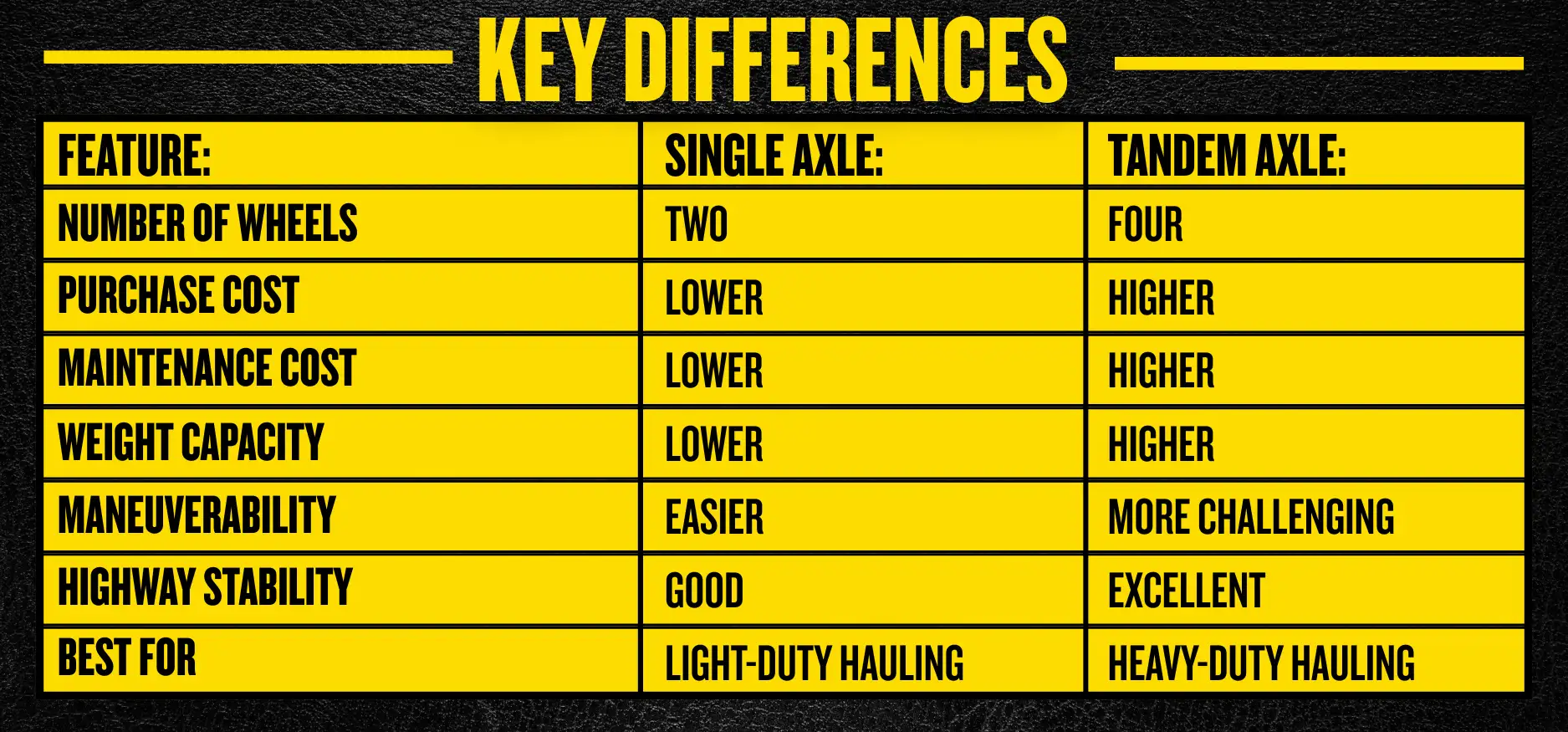
One of the biggest differences is how each trailer handles weight. Single-axle trailers are designed for lighter-duty applications, while tandem-axle trailers provide additional support for heavier cargo.
Tandem axles can also provide added stability on longer trips. Because the trailer has four wheels supporting the load, weight is distributed more evenly, which can contribute to a more stable towing experience, particularly with heavier loads.
Another benefit of tandem-axle trailers is added redundancy. In the event of a tire failure, the remaining tire on that side can temporarily help support the trailer, giving the driver a better opportunity to maintain control and safely pull off the road. While a blowout should always be addressed immediately, this additional support can provide an extra margin of safety compared to a single-axle trailer.
However, that additional capability comes with tradeoffs. Tandem-axle trailers typically cost more upfront, weigh more, and require additional maintenance because they have more tires, brakes, and moving parts.
Which Trailer Is Right for You?
The best trailer is not necessarily the biggest trailer. Instead, it is the trailer that matches your cargo, frequency of use, and towing requirements.
Choose a Single-Axle Trailer If:
A single-axle trailer may be the right choice if you:
- Haul lighter loads
- Use your trailer occasionally
- Need an affordable hauling solution
- Want easier maneuverability and storage
- Primarily transport lawn equipment, ATVs, or household items
For many homeowners and recreational users, a single-axle trailer provides plenty of capacity without the added cost and weight of a tandem-axle model.
Choose a Tandem-Axle Trailer If:
A tandem-axle trailer may be the better option if you:
- Regularly haul heavy equipment
- Transport tractors, vehicles, or construction materials
- Travel long distances on highways
- Need higher payload capacity
- Use your trailer frequently for work or commercial purposes
If your hauling needs continue to grow, investing in a tandem-axle trailer may provide the flexibility and durability needed for future projects.
5×8 to 5×10 Foot Trailers
These compact trailers are popular for:
- Lawn mowers
- Small ATVs
- Yard projects
- Household moves
- General utility hauling
For many homeowners, these sizes provide all the space needed for occasional hauling tasks.
6×12 to 7×14 Foot Trailers
Mid-size trailers offer additional versatility and are commonly used for:
- Side-by-sides and UTVs
- Landscaping equipment
- Building materials
- Larger property maintenance projects
These trailers are often a good fit for customers who need more capacity but do not necessarily require a large commercial trailer.
7×16 Foot and Larger Trailers
Larger trailers are typically chosen for:
- Heavy equipment
- Vehicles
- Commercial hauling
- Agricultural applications
- Construction projects
Many trailers in this size range are equipped with tandem axles to support their higher weight capacities and larger cargo areas.
Common Trailer Buying Mistakes
Purchasing a trailer is an investment, and avoiding a few common mistakes can help ensure you choose the right model.
Buying More Trailer Than You Need
Many buyers assume a larger trailer is automatically a better value. However, a heavier trailer can cost more to purchase, maintain, and tow. If a single-axle trailer meets your hauling requirements, upgrading to a larger tandem-axle model may not provide additional benefits.
Focusing Only on Trailer Dimensions
Length and width matter, but they are only part of the equation. Payload capacity and GVWR are equally important when evaluating whether a trailer can safely handle your intended load.
Ignoring Future Needs
While it is important not to overbuy, it is also worth considering how your hauling needs may change over time. If you anticipate hauling larger equipment or heavier loads in the future, a tandem-axle trailer may offer additional flexibility.
Forgetting to Check Towing Capacity
Even the best trailer is only effective if your vehicle can safely tow it. Always compare your truck’s towing capacity to the trailer’s GVWR and expected cargo weight.
Can Your Truck Tow It?
One of the most important factors in choosing a trailer is ensuring your vehicle is capable of towing it safely.
Before purchasing a trailer, review your vehicle’s:
- Maximum towing capacity
- Payload capacity
- Hitch rating
- Gross Combined Weight Rating (GCWR)
You should also understand the trailer’s Gross Vehicle Weight Rating (GVWR), which represents the maximum allowable weight of the trailer and cargo combined.
For example, a homeowner hauling a riding mower on a trailer with a 3,000-pound GVWR has very different towing requirements than a contractor hauling equipment on a trailer with a 10,000- or 14,000-pound GVWR. Understanding those numbers can help you select a trailer that matches both your hauling needs and your vehicle’s capabilities.
A tandem-axle trailer does not automatically require a heavy-duty truck, but every towing setup should be evaluated carefully before hitting the road.
If you’re unsure where to start, our team at H&H Truck and Outdoor trailer dealers in Alabama can help you determine which trailer options fit both your hauling requirements and your vehicle.
What If a Standard Trailer Doesn’t Fit Your Needs?
While many customers find exactly what they need among standard utility, enclosed, equipment, and dump trailers, not every hauling situation is the same.
Some customers need additional trailer length, higher sides, increased payload capacity, or a configuration built around a specific piece of equipment. In those situations, a custom trailer may be the most practical solution.
H&H Truck and Outdoor offers custom trailer options designed to help customers get the exact features, dimensions, and capabilities they need for the job.
Why Choose H&H Truck and Outdoor for Your New Trailer
As an Alabama-based trailer dealer, H&H Truck and Outdoor understands the hauling demands that come with life across the Southeast, from hauling equipment on the farm to loading up ATVs for a weekend outdoors. We offer a wide selection of new single-axle and tandem-axle trailers, including utility, enclosed, equipment, dump, and car hauler models, so you can find the right fit for your specific towing needs and budget. Our team takes the time to walk you through GVWR, payload capacity, and towing requirements so you drive away with a trailer that matches your vehicle and your workload, not just one that looks good on the lot. Need something built to exact specs? We also offer custom trailer options along with financing to help make ownership easier. When you buy from H&H, you’re getting local, knowledgeable service from a dealer that’s invested in Alabama and the customers we serve.
Find the Right Trailer for the Job
Investing in a quality trailer doesn’t have to strain your budget. H&H Truck and Outdoor offers financing options to help make your purchase more affordable, so you can get the trailer you need without compromising on quality. Ready to find the right trailer? Visit H&H Truck and Outdoor or contact us to explore utility trailers, enclosed trailers, equipment trailers, dump trailers, and custom trailer solutions in Alabama, designed to tackle jobs of every size.
Shop Now
Frequently Asked Questions
1. What’s the main difference between a single-axle and tandem-axle trailer?
A single-axle trailer has one axle and two wheels, making it lighter and more affordable. A tandem-axle trailer has two axles and four wheels, which spreads the load across more tires for greater stability and higher payload capacity.
2. Is a single-axle or tandem-axle trailer better for hauling a lawn mower or ATV?
A single-axle trailer is usually the better fit for lighter loads like lawn mowers, ATVs, and household items. It’s easier to maneuver, cheaper to maintain, and provides plenty of capacity for occasional use.
3. Do tandem-axle trailers tow more safely at highway speeds?
Tandem-axle trailers generally offer more stability on longer highway trips because the load is distributed across four tires instead of two, which can result in a smoother, more controlled towing experience with heavier cargo.
4. What happens if a tire blows out on a tandem-axle trailer?
With a tandem-axle trailer, the remaining tire on that side can help temporarily support the trailer’s weight if one tire fails, giving the driver more time to safely pull over. Single-axle trailers don’t have this redundancy, so a blowout there has a more immediate impact on control.
5. Do tandem-axle trailers cost more to maintain than single-axle trailers?
Yes. Tandem-axle trailers have more tires, brakes, and moving parts than single-axle models, which typically means higher upfront costs and more ongoing maintenance.
6. What size trailer do I need for a UTV or side-by-side?
Mid-size trailers in the 6×12 to 7×14 foot range are commonly used for UTVs and side-by-sides, offering more room than compact 5×8 to 5×10 foot trailers while still being manageable for most towing setups.
7. How do I know if my truck can tow a tandem-axle trailer?
Check your vehicle’s maximum towing capacity, payload capacity, hitch rating, and Gross Combined Weight Rating (GCWR), then compare those numbers to the trailer’s Gross Vehicle Weight Rating (GVWR) and your expected cargo weight.
8. Are tandem-axle trailers required for hauling tractors or heavy equipment?
Tandem-axle trailers are commonly used for tractors, heavy equipment, and other high-weight loads because they offer greater payload capacity and stability. Many trailers in the 7×16-foot-and-larger category come standard with tandem axles for this reason.
9. Can I get a custom trailer if standard sizes don’t fit my needs?
Yes. If you need extra length, higher sides, increased payload capacity, or a configuration built around specific equipment, a custom trailer can be built to match those exact specifications.
10. Does a tandem-axle trailer always require a heavy-duty truck?
Not necessarily. A tandem-axle trailer doesn’t automatically require a heavy-duty truck, but every towing setup — vehicle capacity, hitch rating, and trailer GVWR — should be evaluated before towing.